Of Satanic Subterfuge

Every age gets the devil it deserves.
If monarchial unrest gave us Milton’s sullen, civil warring upstart, and an era of enlightenment delivered Goethe’s wry, witty, world-weary Mephistopheles, it should come as no surprise that our contemporary vision of Satan mirrors our own sensibilities just as well. These days, art and entertainment typically feature Old Scratch and his agents wearing business suits and toting briefcases, but the updated attire indicates a visitation of an older trope: that richly medieval image of the devil-as-deal-maker. And, given the nature of modern deal-making, our Satan has become supremely political, and very litigious.
I want to think with you shortly about a strange thread of Satanic politics we’ve encountered lately, primarily through lawsuits prodding the limitations of the protection of religious liberties. But before that, I’d like to outline exactly what element of Satan’s character I intend to consider here, since his presence is used to invoke a multitude of meanings.
Over time, the figure of Satan has taken on a kind of capaciousness that few other characters, mythical or historical, could ever rival. Almost any imagination can be mapped onto him with some kind of plausibility; it is hard to begrudge the mass of interpretations precisely because the act of looking upon the glory of God and turning away from it is such a profoundly disorienting one. Who can this character possibly be? Can his doomed rebellion tell us something about ourselves? Augustine, among others, viewed the fall of man as essentially a recapitulation of the first diabolical sin, and tended to imagine Satan’s defection as the limit case (as Charles Taylor puts it) of sin itself.
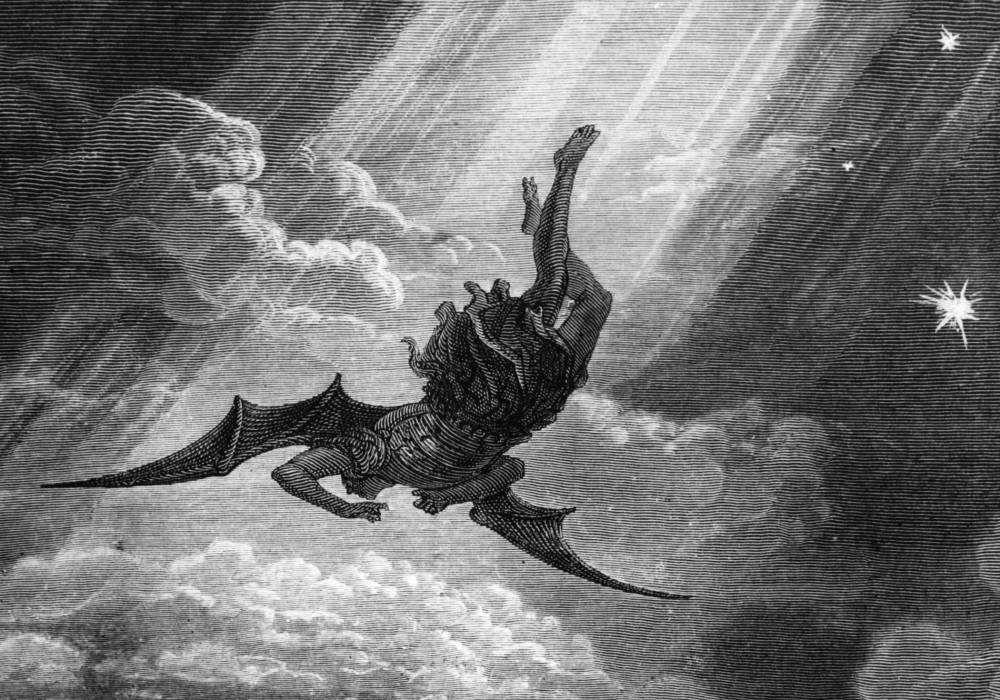
For Augustine, Satan’s sin forms a clean case for consideration because it wasn’t constrained or coerced by anything; he wasn’t confused, cajoled, or subject to the vicissitudes of a fallen world. Instead, he committed what is for Augustine the archetypal moral evil: He freely chose to delight in himself rather than God, and in doing so destroyed himself. As Augustine writes, “That angel [Lucifer], delighting in himself rather than in God, was unwilling to be subject to Him and swollen with pride: he abandoned the Highest Essence, and he fell.” Because evil is non-being in Augustine’s ontology, Satan’s apostasy meant a diminishment, a lessening, a turn toward non-existence. This is what Augustine means when he says that Satan abandoned the Highest Essence: Without God, Satan is eternally reduced, evermore lacking, and, it seems, gradually decreasing toward his eventual total negation. Satan is the embodiment of evil, therefore, in that he is the first creature to will his own destruction, and in that his diabolical sin represents the most extreme, archetypal turn toward non-existence.
Satan is, therefore, principally caught up in his own undoing. His nature as we now know it (as opposed to the nature he abdicated) is defined by its unmaking. He is what he is because he willfully chose the path of non-being, and if we are to know him by his works, then we will know him by falsehood, inauthenticity, and ruin.
And so we do, especially as of late. Recently, Satan has spilled ink in politics mainly through the work of Satanists, whose title is more accurate than they understand it to be. ‘Satanism’ is technically an incoherent label encompassing an undefined set of non-believers who, despite their total lack of unifying characteristics, have generated an impressive media profile in the last several months. During the run up to the “black mass” that never panned out at Harvard earlier this year, a spokesman for the Satanic Temple invited to demonstrate the ceremony declared that Satanism is nothing but a “humanist group” that uses Satan as a “symbol of rejecting superstition, authority, and organized religion.” This was the same group that lobbied in January to build a Satanic monument at the Oklahoma Statehouse, with the same media-lusty spokesman explaining the impetus for the monument:
Today, we are rightly offended by the notion of blasphemy laws and divine fiats. Acknowledging wrongful persecutions has helped shape the legal system that preserves the sovereignty of our skeptics, heretics, and the misunderstood. It has shaped a proud culture of tolerance and free inquiry. This is to be a historical marker commemorating the scapegoats, the marginalized, the demonized minority, and the unjustly outcast.
Yet again, the Satanic Temple, with its same doggedly headline-hungry spokesman, sought exemptions from abortion legislation regarding informed consent following this year’s Hobby Lobby ruling, arguing that:
While we feel we have a strong case for an exemption regardless of the Hobby Lobby ruling, the Supreme Court has decided that religious beliefs are so sacrosanct that they can even trump scientific fact. This was made clear when they allowed Hobby Lobby to claim certain contraceptives were abortifacients, when in fact they are not. Because of the respect the Court has given to religious beliefs, and the fact that our beliefs are based on best available knowledge, we expect that our belief in the illegitimacy of state mandated ‘informational’ material is enough to exempt us, and those who hold our beliefs, from having to receive them.
After so much litigious Satanic pabulum spouted into the public sphere by one particular office of the decentralized Satanic community, it was almost refreshing to see a new Satanist in the news—on this most recent occasion, a cell of Oklahoma Satanists claimed that they had attained a consecrated host they intended to use in a “black mass,” and asserted their intent to carry out their plan regardless of protest. Of course, they almost immediately folded after Archbishop Paul Coakley filed a lawsuit seeking return of the host, which is now undefiled in the hands of the Church.
It seems we’ll see no end to litigious agitation on behalf of self-styled Satanists, and the pattern that has emerged so far involves them cloaking themselves in the protections guaranteed religious groups in the United States without even vaguely resembling a religion. Each time Satanists are called upon to explain their stake in whatever legal issue they’ve raised, they very clearly explain that they believe nothing, have no particular principles but rather only extremely contingent goals, and express only mild, easily deflated commitment to their own rituals, ceremonies, and activities—all of which are completely derivative of Christian practice. Today’s Satanists do not even believe in Satan; they’re run-of-the-mill secular humanists with run-of-the-mill secular humanist political projects, the likes of which are typical of Dawkinsian types. On this count alone, it is a little troubling that they receive any traction or political protection qua ‘Satanists’ whatsoever.
And yet, if there was ever a religion that reflected Satan as he actually is, this just might be it: a non-religious group merely proposing the artifice of a religious group, so that they can systematically attack protections guaranteed to genuine religious groups. In each recent case Satanists have interacted with the state, their goal has been to destroy the special legal provisions made to protect legitimate religious belief and practice; in this sense, even their coy self-identification as a faith would eventually be rendered meaningless by the success of their own machinations. Because they detest faith and religion at large, they mimic its legal form in an effort to collapse those categories altogether.
It is a spot-on Satan imitation for a group of people that claims not to take his existence seriously. He is the ultimate un-maker, a destructor, a creature of sheer deception whose pretense is tied up in the fact of his own ongoing diminishment. So far, these litigious Satanists have enjoyed very little political or legal traction, likely because their existence very obviously follows from the design of religious legal protections rather than preceding them. They are probably not worth worrying about. But the nature of their mission highlights something of a weakness in the rhetoric of our public discourse when it comes to naming that which is inauthentic, especially under the cloak of rights language.